Did anyone get blood work before propecia and then after 4 or 5 years check again and have normal estrogen still? The most worrying thing to me about propecia is long term having much higher then normal estrogen. Does it not change much for most men on propecia even after 5, 10, or 15 years since you use for a lifetime?

You are using an out of date browser. It may not display this or other websites correctly.
You should upgrade or use an alternative browser.
You should upgrade or use an alternative browser.
People on propecia with normal estrogen
- Thread starter abcdefg
- Start date

- Reaction score
- 43
abcdefg said:The most worrying thing to me about propecia is long term having much higher then normal estrogen.
Just curious: what would you personally consider to be a "much higher" level of estrogen? If there were 5% more estrogen, would you consider that to be "much higher"? Or would it require 10% or more? How do you feel about that?
Lets say the normal mans estrogen level is 10 (made up) and yours is 12 which is within the normal estrogen range for a man. After 5 years on propecia your estrogen level is above the upper limit on the normal range of estrogen for a man according to a doctor that has experience in that. I would consider that to be higher then normal. There is no real percentage just higher then most other men when you started with a normal estrogen level.
- Reaction score
- 43
abcdefg said:Lets say the normal mans estrogen level is 10 (made up) and yours is 12 which is within the normal estrogen range for a man. After 5 years on propecia your estrogen level is above the upper limit on the normal range of estrogen for a man according to a doctor that has experience in that. I would consider that to be higher then normal.
Yes, but I want you to be more specific than that. I want you to give me a number that you consider to be "much higher" than normal.
abcdefg said:There is no real percentage just higher then most other men when you started with a normal estrogen level.
Huh? What do you mean, "there is no real percentage"?? If your estrogen level were higher than 51% of all the other men on the planet, it would meet that stipulation: it would be "higher than most other men"!
 But would you get really upset if that were the case? If your estrogen were only slightly higher than average? That's why I want you to give me a NUMBER.
I dont know how reliable this is but something from a blood testing company would be pretty reliable. So anything above 70 picograms per milliliter would be very high. This is just from a thread in a steroid forum so its certainly pretty far from scientific but just as an example.
http://forums.steroid.com/showthread.php?t=347127
Estrogen
Estrogen (measured as estradiol) should be in the mid- to lower-normal range. If estradiol levels are in the upper one-third of the normal reference range, or above the normal reference range, this excessive level of estrogen should be reduced. Labcorp lists a reference range of between 3-70 picogram/mL for estradiol while Quest states a reference range of between 10-50. For optimal health, estradiol should be in the range of 10-30 picogram/mL for a man of any age.
The fact that most aging men have too much estrogen does not mean it is acceptable for a man to have low estrogen. Estrogen is used by men to maintain bone density, and abnormally low estrogen levels may increase the risk for prostate cancer and osteoporosis. The objective is to achieve hormone balance, not to create sky-high testosterone levels without enough estrogen. The problem is that, if we do nothing, most men will have too much estrogen and far too little testosterone.
http://forums.steroid.com/showthread.php?t=347127
Estrogen
Estrogen (measured as estradiol) should be in the mid- to lower-normal range. If estradiol levels are in the upper one-third of the normal reference range, or above the normal reference range, this excessive level of estrogen should be reduced. Labcorp lists a reference range of between 3-70 picogram/mL for estradiol while Quest states a reference range of between 10-50. For optimal health, estradiol should be in the range of 10-30 picogram/mL for a man of any age.
The fact that most aging men have too much estrogen does not mean it is acceptable for a man to have low estrogen. Estrogen is used by men to maintain bone density, and abnormally low estrogen levels may increase the risk for prostate cancer and osteoporosis. The objective is to achieve hormone balance, not to create sky-high testosterone levels without enough estrogen. The problem is that, if we do nothing, most men will have too much estrogen and far too little testosterone.
- Reaction score
- 43
It sounds like you think anything around 50% to 66% again higher estrogen (or more) than the dead-center of those ranges (at least the two with narrower specifications) would be "much higher".
Tell me this: how much do you think finasteride raises estrogen?
Tell me this: how much do you think finasteride raises estrogen?
- Reaction score
- 43
abcdefg said:A complete guess but maybe around 20 percent?
My own complete guess is that since estrogen (I'm talking estradiol here) is made from testosterone, maybe it rises around 5%-10% or so, same as testosterone.
abcdefg said:Finasteride lowers DHT by about 80 percent but I dont know how estrogen balances out with DHT or how many other hormones factor into that delicate balance.
Tell me more about this "balance out" business with estrogen and DHT. Have you been paying too much attention to misterE?
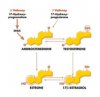
Both testosterone and estrogene is synthesized from a prohomone called androstenedione. Androstenedione can be converted directly to both testosterone (wich is AN androgen) and estrone (wich is AN estrogen) via two different routes and enzymes (wich I don´t remember the names of). Estrone can be further converted into Beta- estradiol.
Testosterone can, however, also be converted into Beta- estradiol via the enzyme aromatase. Aromatase converts testosterone BUT NOT DHT.
Now, a natural equilibrium exists between testosterone and the estrogenes estrone and B- estradiol, based on complex physiological feed- back regulations (wich may vary from individual to individual). Taking finasteride could increase the serum level of testosterone, thus pushing the equilibrium towards more estrogen (more B- estradiol, to be specific.
This would help to explain the gynecomnastia some people experience as a side effect from finasteride.
EDIT: to clarify; estrogen is not a single hormone, but a term used for a group of hormones. The most common estrogenes in men are estrone and estradiol. Progesterone is also an estrogen. Testosterone is an androgen, wich is also a term used for a group of hormones. Dihydrotestosterone is an androgen.
Testosterone can, however, also be converted into Beta- estradiol via the enzyme aromatase. Aromatase converts testosterone BUT NOT DHT.
Now, a natural equilibrium exists between testosterone and the estrogenes estrone and B- estradiol, based on complex physiological feed- back regulations (wich may vary from individual to individual). Taking finasteride could increase the serum level of testosterone, thus pushing the equilibrium towards more estrogen (more B- estradiol, to be specific.
This would help to explain the gynecomnastia some people experience as a side effect from finasteride.
EDIT: to clarify; estrogen is not a single hormone, but a term used for a group of hormones. The most common estrogenes in men are estrone and estradiol. Progesterone is also an estrogen. Testosterone is an androgen, wich is also a term used for a group of hormones. Dihydrotestosterone is an androgen.

amsch
Senior Member
- Reaction score
- 1
Bryan said:It sounds like you think anything around 50% to 66% again higher estrogen (or more) than the dead-center of those ranges (at least the two with narrower specifications) would be "much higher".
Tell me this: how much do you think finasteride raises estrogen?
Hm, maybe 100 - 200%?
viewtopic.php?f=11&t=53740&p=513957&hilit=+amsch+bloodwork#p513957
- Reaction score
- 43
amsch said:Hm, maybe 100 - 200%?
Why do you suppose finasteride studies have reported no significant effects on estrogen?
amsch
Senior Member
- Reaction score
- 1
Bryan said:amsch said:Hm, maybe 100 - 200%?
Why do you suppose finasteride studies have reported no significant effects on estrogen?
Can you show me those "no significant effects"?
All I can say is i wasn't worrying too much when starting finasteride, as there's supposed to be a "slight increase in estrogen" only. I know you always refer to studies with 1000s of people, bryan. However, I'm one of the few ones who regularly post their blood results on this board. Do you really think, ME, the only one out of thousand posting his blood results (I started those BEFORE noticing breast enlargement on my left breast), is the only one of thousands who get a very high change in estrogen?
Coincidence?
- Reaction score
- 43
Todd said:Now, a natural equilibrium exists between testosterone and the estrogenes estrone and B- estradiol, based on complex physiological feed- back regulations (wich may vary from individual to individual).
Do you really think that the production of estrogen is controlled by a mechanism that involves or includes a feedback loop? Can you cite any medical references in support of that idea?
- Reaction score
- 43
amsch said:Bryan said:Why do you suppose finasteride studies have reported no significant effects on estrogen?
Can you show me those "no significant effects"?
Here's one such study (there are others, too): "Effects of Finasteride (MK-906), a 5a-Reductase Inhibitor, on Circulating Androgens in Male Volunteers", J Clin Endocrinol Metab 70: 1136-1141, 1990. Here's the abstract to the study:
"Finasteride, a 5 alpha-reductase inhibitor, was administered to normal male volunteers in a blinded placebo-controlled study at daily oral doses of 25, 50, and 100 mg for 11 days (part 1) and daily oral doses of 0.04, 0.12, 0.2, and 1.0 mg for 14 days (part 2). Results from part 1 showed a significant reduction in dihydrotestosterone (DHT) at all doses and a significant increase in both testosterone (T) and delta 4-androstenedione at the 50- and 100-mg doses. No change was seen in LH, FSH, cortisol, or estradiol levels. Serum lipids, including total cholesterol, low density lipoprotein, high density lipoprotein, and triglycerides were not affected by treatment. Results from part 2 again showed significant reduction in DHT at all doses. DHT levels returned to pretreatment values within 14 days of discontinuing treatment. Significant increases in T were observed only in the 1.0 mg group and only during the first 8 days of treatment. The T/DHT ratio increased with all doses and returned to baseline when drug was discontinued. The DHT metabolites and androstanediol glucuronide and androsterone glucuronide were significantly reduced at all doses. There were no significant adverse experiences reported during part 1 or 2. In conclusion, finasteride is well tolerated by normal volunteers and results in significant suppression of serum DHT at all doses tested."
Here's part of their Table 3, showing the actual before-and-after estradiol measurements while taking finasteride:
Treatment group ............ Estradiol (Baseline) ....... Estradiol (Day 11)
placebo (n=12) ................... 0.11 +/- 0.03 ............. 0.10 +/- 0.03
12.5 mg, twice daily (n=10) .... 0.10 +/- 0.03 ............. 0.10 +/- 0.04
50 mg, daily (n=10) ............. 0.10 +/- 0.03 .............. 0.10 +/- 0.03
50 mg, twice daily (n=10) ...... 0.11 +/- 0.03 .............. 0.10 +/- 0.02
- Reaction score
- 43
amsch said:Thanks for posting that.
However, this does not explaint while many users notice breast enlargement (not always full-blown gyno) while on finasteride.
Maybe it has to do with the sharp reduction of DHT.
amsch said:And how do you explain my bloodwork?
I've always had a basic distrust of blood tests. I've always felt that you have to have a number of them done, before you can be reasonably confident that the results are accurate and consistent. I couldn't help but notice that you showed the results of four different blood tests that were done AFTER you had stopped taking the finasteride (and notice the fluctuations in those four tests), but you only had one test while you were still ON the drug. I don't fully trust the estradiol measurement from just one such blood test.
Bryan said:Todd said:Now, a natural equilibrium exists between testosterone and the estrogenes estrone and B- estradiol, based on complex physiological feed- back regulations (wich may vary from individual to individual).
Do you really think that the production of estrogen is controlled by a mechanism that involves or includes a feedback loop? Can you cite any medical references in support of that idea?
Sure, Bryan.
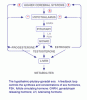
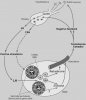
In the first image, you can see how the production of estrogen feeds back on the hypothalamus and higher cerebral systems to regulate it self. The same goes for testosterone.
Attachments
amsch
Senior Member
- Reaction score
- 1
Bryan said:amsch said:Thanks for posting that.
However, this does not explaint while many users notice breast enlargement (not always full-blown gyno) while on finasteride.
Maybe it has to do with the sharp reduction of DHT.
So why should drugs like arimidex and tamoxifen help in that case?